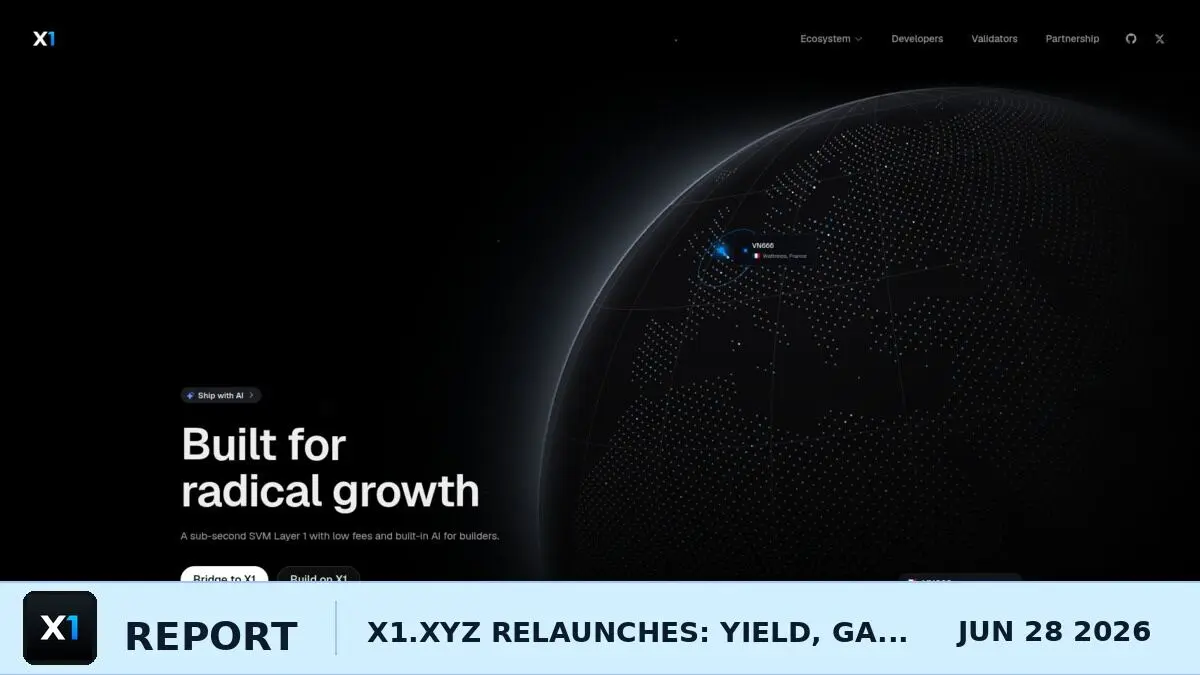
X1 Labs did not send a press release. There was no countdown timer, no coordinated tweet thread, no Medium post with a TL;DR at the top. Instead, today the team unveiled next.x1.xyz — a rebuilt version of the main site that sits alongside the existing x1.xyz. Both are live. The new one is so dense with quietly confirmed products that it functions as a launch document on its own.
If you have not visited next.x1.xyz yet, the first thing you notice is the design. An obsidian-black canvas with animated elements that move with enough restraint to feel engineered, not decorated. The typography is sharp, the layout breathes, and nothing fights for your attention. It reads as the work of a team that has moved from building in the open to presenting something finished.
USDC.X Gets a Yield Mechanism — Coming Soon
The most consequential piece on the new site is not a product page. It is a staking announcement for USDC.X, the dollar-pegged stablecoin that has been live on X1 since the Warp Bridge launched. The mechanism is already understood: every USDC.X in circulation is backed 1:1 by real USDC locked on Solana. The bridge mints USDC.X on the X1 side when you deposit, and burns it when you withdraw. No custodian holds your funds — the bridge contracts do, and anyone can verify the balances on-chain.
What the new site introduces is the yield layer that will sit on top of that stablecoin. Holders will be able to stake USDC.X to back bridge liquidity and earn XNT in return. The rewards will be drawn from network inflation and paid out over time. The staking mechanism is not live yet, but it is confirmed on the site — not a rumour, not a leak. Native XNT yield, paid to dollar holders, drawn from the same inflation pool that pays validators for producing blocks.
The economic implication is significant. Until now, there was no particular reason to hold USDC.X on X1 rather than USDC on Solana beyond whatever you needed it for on-chain. A yield incentive changes that directly: bring stablecoins over, earn network rewards. If adoption is meaningful, it deepens bridge liquidity organically, which benefits every application that touches cross-chain transfers.
The Warp Bridge in Full Detail
The Warp Bridge has been operational, but the new site gives it a formal presentation worth understanding. The bridge supports two-way movement of assets between Solana and X1: currently USDC, XENCAT, and DGN, with more assets listed as coming soon. The flow is direct — deposit on Solana, receive the equivalent on X1, move back whenever you want, always at a 1:1 ratio on the USDC pair.
The security architecture is serious. Five guardians watch the bridge, and the multisig layer runs on Squads Protocol. No single party can approve a transfer. The contract holds custody of user assets, not a company, which means the collateral is auditable in real time. That is the standard the industry has set for credible bridges after years of hacks tied to centralised validator sets and opaque multisig arrangements.
Speed and simplicity are the practical advantages. Warp is not a hop-and-wait experience. The bridging process is fast enough that it becomes a feature rather than a friction point, which matters for liquidity provisioning and arbitrage flows that require predictable settlement windows.
X1 Games Portal: Four Titles, XNT Rewards, Builder Entry Point
X1 Games has been in development for a while, visible to anyone who followed the Tetris battle bot scene in the staging environment. The new site formalises what was always intended: a dedicated gaming portal with four titles currently on display — Chess, Tetris, Drift, and Block Breaker. Players can compete in matches and tournaments and earn XP alongside XNT rewards.
The more interesting element is the builder side. The portal is designed to accept external game developers who want to bring their titles to X1. Builder competitions are part of the roadmap, giving developers a commercial reason to integrate rather than just a technical one. This positions X1 Games as a platform, not a product — a distribution channel for on-chain games with a native economic layer.
Earning XNT through gameplay creates a new acquisition funnel for the token that does not involve buying it on an exchange. Players who accumulate XNT through wins and tournaments may convert some of it, may stake it, or may never sell it — but either way, they are holding an asset tied to the network's economic health, which changes their relationship to the chain.
Validator Economics on Display
The validators section of next.x1.xyz is the most data-dense part of the site, and the numbers it presents are striking. Eighty-six percent of total XNT supply is currently staked. With 659 active validators and a Nakamoto coefficient above 52, the network is distributed by the standards of any serious chain. The stats are not projections — they reflect current epoch data.
There are four distinct income streams for validators. Voting rewards arrive every epoch based on participation and vote credits. Delegation commissions are set by each validator and earned when delegators choose them. Block rewards give validators 50% of every transaction fee on the blocks they produce — the other half is burned, feeding the deflationary model. The Bootstrap Bonus adds a 16% APY for qualifying validators, which functions as an explicit incentive to come online early and stay online.
The 10x boost from X1 Foundation delegation is not guaranteed, but the mechanism is clear: validators that meet the Project Capybara criteria receive delegated stake from the Foundation, multiplying their effective position without requiring that stake to come from their own pocket. For a validator with 3,000 XNT of self-stake, the difference between earning on 3,000 XNT and earning on a boosted position is substantial across a year of epochs. Full eligibility requirements are covered in our complete validator delegation guide.
The epoch reward data shown on the site — 17 to 19 XNT per epoch across recent history — gives validators a concrete picture of what consistent performance looks like. Variance this low across eight consecutive epochs suggests the reward mechanism is stable. Validators can join and discuss performance in the X1 Validators Telegram channel.
Theo, the Builders Telegram, and SVM Compatibility
The developer section leads with the core value proposition: X1 is SVM-compatible, which means any program that runs on Solana runs on X1 without modification. Change the RPC endpoint and deploy the same binary. That is the pitch, and it is an honest one — the technical foundation is identical enough that migration cost is close to zero for teams already building on Solana.
Theo is the AI agent X1 Labs has integrated into the developer experience. He is wired directly into the live chain and the ecosystem's documentation, meaning questions about on-chain state, protocol specifics, and API behaviour get answers grounded in current data rather than a static training snapshot. Builders can interact with Theo to debug integrations, understand protocol mechanics, or explore what is deployed on-chain.
For teams that prefer human support, two Telegram communities are live: a general builders group at t.me/x1_builders and Cyberdyne at the Cyberdyne channel, which pairs Theo with direct access to people. The full documentation and resources are at docs.x1.xyz/build-on-x1/resources.
X1Prism Gets Its Moment
X1Prism.xyz has been operating as an independent tool, but its placement as an entry point on the new site gives it official positioning. The suite covers three functions: a validator dashboard, a bridge monitor, and an on-chain explorer. Together they constitute the observability layer most active participants in the ecosystem were building workarounds for. Having them in one place, linked from the primary domain, changes the workflow for validators, delegators, and developers tracking state across the bridge and the chain simultaneously.
X1 Wallet Heads to Mobile
The X1 Wallet Chrome extension is live now, and next.x1.xyz confirms what many expected: iOS and Android versions are in development. The wallet is native to X1 and Solana, supporting NFTs, hardware wallet pairing via Ledger and Trezor, and native XNT staking without leaving the app. Staking through the wallet mints pXNT, a liquid receipt token that can be held or traded.
Smart priority fees are a feature worth noting. The wallet reads current network conditions and adjusts the priority fee automatically, eliminating the most common failure mode for inexperienced users: submitting transactions with fees too low for the current block space environment. Mobile availability will extend the network's accessible user base substantially when it arrives.
A SOON Button Nobody Is Ignoring
Near the bottom of the new site is a disabled button labelled Moon Party, tagged SOON. In isolation it would be a minor detail. In the context of the XEN and X1 community, it is not minor at all.
Moon Party has a specific meaning in this ecosystem: a burn event that pulls XEN tokens from up to 14 different chains and destroys them in a coordinated ceremony. These events have historically been significant for XEN holders and for any chain participating in them. Whether this Moon Party is that event has not been confirmed. X1 Labs has said nothing about it officially. But the button exists, it is disabled, and it is on the homepage of next.x1.xyz. That is not accidental product placement.
If it is what the community suspects, it would be the largest token burn event in the XEN ecosystem to date, executed on X1, pulling attention from every chain where XEN currently lives.
Perps and Prediction Markets
One more line on the new site: Perps and predictions. Go long or short on majors, plus prediction markets. No launch date. No further detail. But its presence alongside XDEX confirms that derivatives trading is part of X1's near-term financial infrastructure roadmap. Prediction markets alongside perpetuals suggest the team is building toward a full-spectrum on-chain trading environment, not just a spot exchange.
What next.x1.xyz Is Saying Without Saying It
The chain has 5,500 TPS, 659 validators, a Nakamoto coefficient above 52, and 86% of supply staked. It has a working bridge, a live DEX, a stablecoin with a yield mechanism confirmed and incoming, a gaming portal, and a developer ecosystem with documentation, an AI agent, and two active builder communities. None of this is vaporware — all of it is verifiable on-chain or in production.
The new site did not announce any of these things in the traditional sense. It displayed them. For a team that has spent the better part of a year building without theatrical reveals, that restraint is consistent. Whether it reaches the audiences who have not been watching is the next question. The material is there. The surface area of the network is growing. The economics for validators, stablecoin holders, gamers, and builders are all pointing in the same direction.
The Moon Party button is still greyed out. It will not stay that way forever.