
A new storage app launched on X1 on October 19. X1 VAULT at x1vault.com writes files directly into the X1 blockchain. You pay once, and every validator on the network keeps a copy. There is nothing to renew. The launch was announced by Jozef from xen.pub, whose XEN.PUB validators help run X1.
The pitch on the home page is short: "Save anything once. Keep it forever."
The name is close to one we have covered before, so to be clear: this is not X1 Vault at vault.x1.xyz, which encrypts files and stores them on IPFS. X1 VAULT at x1vault.com puts the file itself on chain.
How a file goes on chain
You can save text, a message, any file or a small web page, up to 100 MB. The app splits it into 9 KB pieces, hashes it with BLAKE3 and writes each piece to its own X1 account. It takes four steps:
- Choose. Pick the content. You can compress it with gzip and encrypt it with a password.
- Approve. Your wallet approves one setup transaction. A temporary key then writes the pieces, so you do not have to sign hundreds of times.
- Seal. The file is sealed with its BLAKE3 hash. From then on its contents and address are final.
- Keep. Every validator holds the accounts. You can open the file from My files, share a link or read it from any node.
On chain each saved file is called an "inscription". The X1 VAULT program has no instruction that changes or deletes a sealed file. Only unfinished uploads can be cleared. The file's address is derived from the hash of its bytes, so anyone who fetches a copy can check that it matches exactly.
Why it stays
The idea is simple. A file stored in blockchain accounts lives as long as the chain does. Every X1 validator has to keep every account in order to validate blocks. The home page counted 503 validators holding every saved file on launch day.
Accounts survive only while they hold a rent-exempt deposit. X1 VAULT pays that deposit once, in full, for every piece. That one payment is what makes the file permanent.
What it costs
According to the docs, the price has three parts:
- Storage deposit: about 0.066 XNT per 9 KB piece, plus about 0.02 XNT for the file account.
- Network fees: a fraction of a cent per transaction.
- Platform fee and reward share: 7% platform fee and 3% to the reward pool, both taken as a percentage of the deposit.
That is roughly 7.5 XNT of deposit per megabyte before fees. The Save page shows the exact total before you confirm. Funds go through your vault, an account only your wallet controls, and anything left over from the upload is returned to it.
Private if you want it
Everything on a blockchain is public. If a file should stay private, tick Encrypt when you save. Your browser derives a key from your password with Argon2id and encrypts the content with XChaCha20-Poly1305 before anything leaves your device. The chain only ever sees ciphertext.
Two things to keep in mind. There is no password recovery: lose the password and the file stays locked forever. And filenames are stored on chain, so the name of an unencrypted file is public too.
You do not need the website
X1 VAULT runs no server and no database. The footer says it "reads directly from the X1 chain, no server". The docs explain how to read a file back from any X1 RPC node with a few lines of JavaScript: fetch the file account under program 34JxpA5LRsuVfvTSDtT1omsuZj6mKmuVKhvd6cQj2VYb, fetch each 9 KB piece, join them and check the BLAKE3 hash. If x1vault.com ever disappeared, your files would still be readable.
Every save is a ticket
The 3% reward share goes into an on-chain pool. Each epoch the pool pays out 95% of its balance. The three wallets that saved the most bytes get 35%, 25% and 18%. Two more wallets, drawn at random from the rest of the board, get 12% and 10%. The rest rolls over.
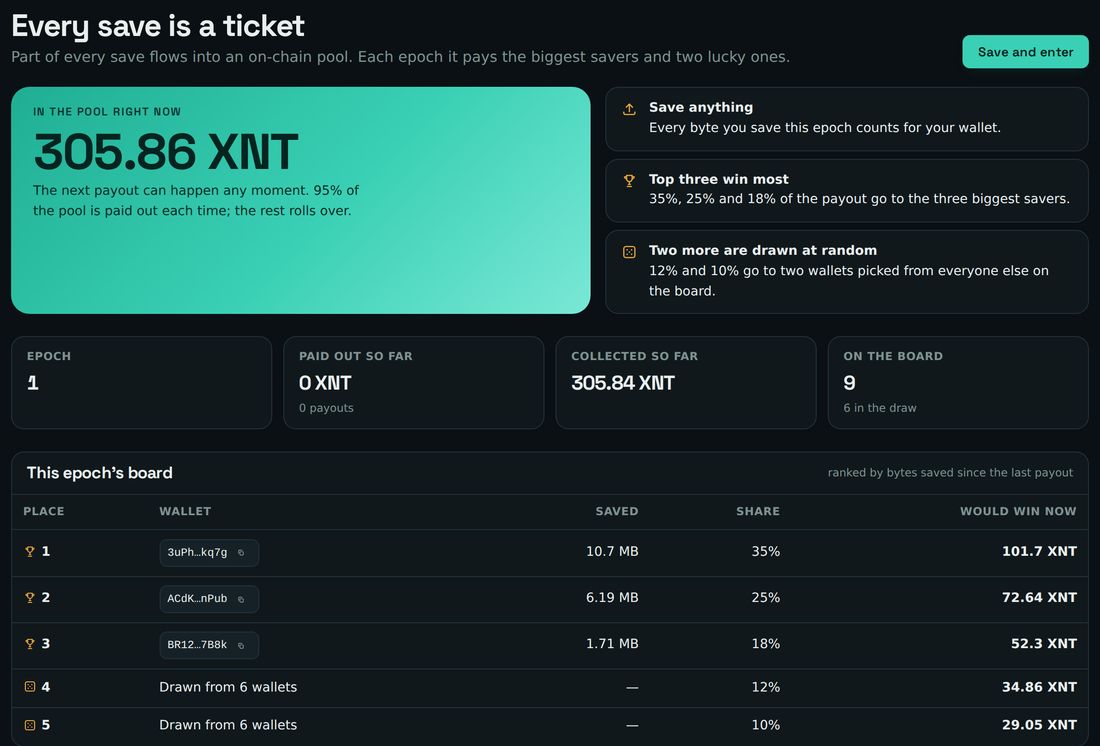
On launch day the pool held 305.86 XNT in epoch 1, with nine wallets on the board and no payout yet.
A market for files
Saved files can be sold. The Market lists files for sale and checks every listing against current ownership on chain. There were 25 listings on launch day with a 5 XNT floor. The first sale was for 15 XNT. Listings ranged from a full King James Bible saved as a web page (25 XNT) to XEN and X1 community images priced in the thousands.
Launch numbers
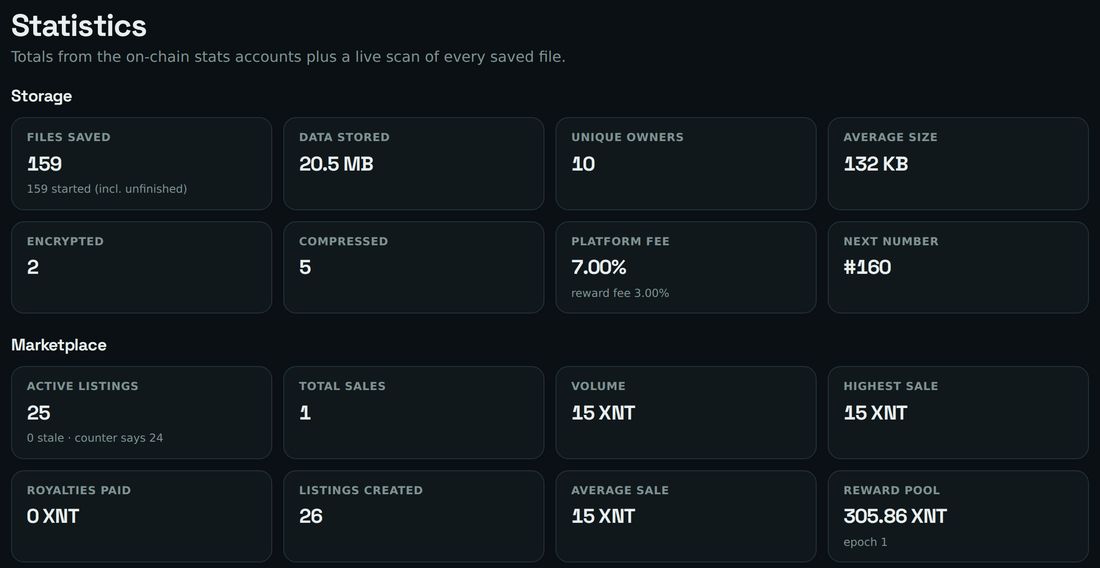
The first files went on chain in the days before the announcement. On October 19 the Stats page showed 159 files and 20.5 MB stored by 10 wallets. Most of them (133) are images, along with 11 text files, 8 web pages, 2 videos and 1 audio file. Two were encrypted. The app is at version 2.0.0, and a switch in the top bar moves it to X1 Testnet so you can try it with test tokens first.
Why it matters
Permanent storage usually means a separate network built for it. X1 VAULT uses the chain X1 already runs. It works because X1 is fast and its fees are low: a file of hundreds of pieces can be written in one session for a one-time price. For artists, archivists and anyone who wants proof that a file existed and was never changed, that is a new tool on X1.