
One day after the owner of the New York Stock Exchange said it wants to bring Hyperliquid perpetual futures to the United States, X1 has its own way in. Early on October 30, X1 founder Jack Levin shared X1 Terminal, a perp DEX front end that connects to Hyperliquid's order book and signs in with X1 Wallet or Phantom. Fees collected by the app, Levin says, will be used to buy XNT and reward users.
Try it: x1-terminal-20261029.vercel.app. This is a candidate build, shared in Levin's words as "use at your own risk". Trade at your own risk: it is an early development product.
The Hyperliquid news that started it
On October 29, Intercontinental Exchange (ICE), the parent of the NYSE, announced a partnership with Trade[XYZ], the largest builder of markets on Hyperliquid, to run a dedicated U.S. market for perpetual futures. CoinDesk reports the venue would be branded ICE[XYZ] and list perps on equities, indices, commodities, FX and crypto, offered through brokers and platforms. Hyperliquid supplies the technology through HIP-3, its builder-deployed market standard. Trade[XYZ] designs the markets. ICE operates the regulated exchange and clearing, and is taking a minority stake in Trade[XYZ]. The plan still needs CFTC approval, and no launch date has been given.
"We see these perp markets as additive to our futures markets, not a replacement for them," ICE chief executive Jeffrey Sprecher said, according to The Block. "We intend to find retail traders where they want to be."
Then came the post that sent it around the internet. Billionaire investor Stanley Druckenmiller published his first ever post on X:
"I am excited to be an investor in trade(xyz) as they partner with ICE to bring 24/7 perpetual futures on Hyperliquid to the United States. As a market participant, I am looking forward to to using their innovative product to enhance my investment process."
Elon Musk quoted it with one word: "Interesting." HYPE, Hyperliquid's token, rose between 15% and 20% that day, trading above $91 against an all-time high of $97.96, on a day when most of the crypto market was down.
Why Hyperliquid matters, and why the U.S. door is opening
Hyperliquid is the leading on-chain perp DEX. Estimates of its share of decentralized perp volume range from roughly a third to well over half depending on the data set, and on June 8 it cleared a record 7.6% of all exchange perpetual volume, centralized venues included. Trade[XYZ]'s markets alone have done more than $650 billion in volume in just over a year, and it holds the license for the first official S&P 500 perpetual.
Washington has spent 2026 pulling perps onshore. In May, CFTC Chairman Mike Selig's agency issued a staff advisory and no-action relief, and Kalshi became the first U.S. firm cleared to offer a bitcoin perpetual. President Donald Trump mentioned crypto perpetuals for the first time in a Truth Social post that same week, presenting them as a product U.S. policy had pushed offshore. On August 19, at a White House meeting with crypto executives, he went further and named Hyperliquid, saying Selig was working to bring it into the United States "in a fully compliant and legal fashion." Not everyone agrees: CME Group sued the CFTC in June, arguing perps should be regulated as swaps, not futures.
Levin: perp futures on the fast track for X1
Levin reacted the same day in the X1 World Telegram group:
"With today's Hyperliquid news, we are putting Perp. Futures on the fast track on X1. It is quite certain that with U.S. market is opening for legal Perp. trading and X1 is uniquely positioned to take advantage of that."
He pointed out that perps are not a new idea for X1, and that Vero, the BTC prediction market X1 ran as a test launch, was part of the plan. "Vero was a test to see how fast we can settle on chain, and it was super super fast," he wrote. The hard part of on-chain trading is the wallet popup on every order, and "Vero implemented an internal wallet to deal with exactly that issue": you execute each trade "without touching browser wallet at all." Perps were already visible on X1 Labs' roadmap when the new x1.xyz listed them earlier this year.
Then, in typical Levin fashion, he went quiet. A few hours later he was back, posting as Cyphereus Prime:
"This is a candidate version which works with X1 Wallet, use at your own risk, you are familiar with hyperliquid, you should be able to easily use it. You will need X1 wallet switched to Solana network, and deposit SOL. This is perp engine which connects to hyperliquid trading, the fees collected will be used to buy and rewards users with XNT."
What X1 Terminal is
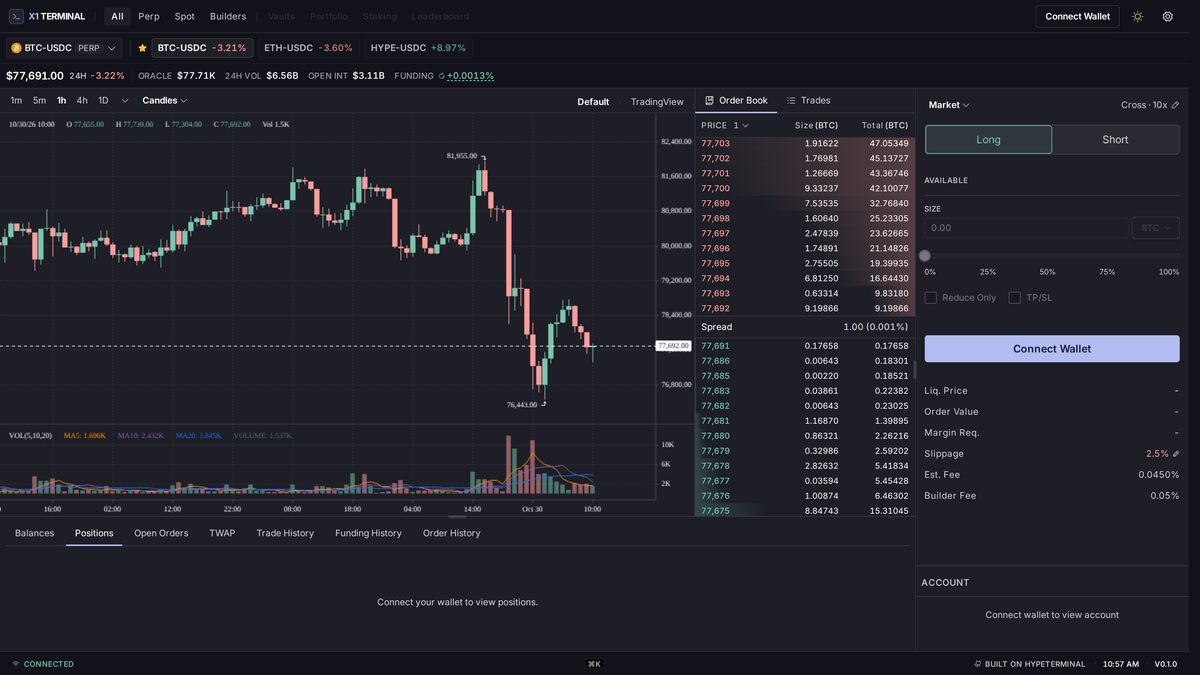
X1 Terminal is a trading front end for Hyperliquid. The order book, prices and liquidity you see are Hyperliquid's: the BTC-USDC perpetual showed $6.56 billion in 24-hour volume and $3.11 billion in open interest when we loaded it. Markets include BTC, ETH and HYPE perps plus spot, and bitcoin can be traded with up to 40x leverage. The order panel defaults to 10x cross margin.
The X1 part is the login. Hyperliquid accounts use Ethereum addresses, so the app offers two ways in:
- Phantom, signing as an Ethereum wallet (EIP-712).
- X1 Wallet, where your Hyperliquid account is derived from your X1 signature. The app signs trades with that derived key and reconnects your session, so there is no wallet popup per order. That is the Vero "internal wallet" idea, applied to Hyperliquid.
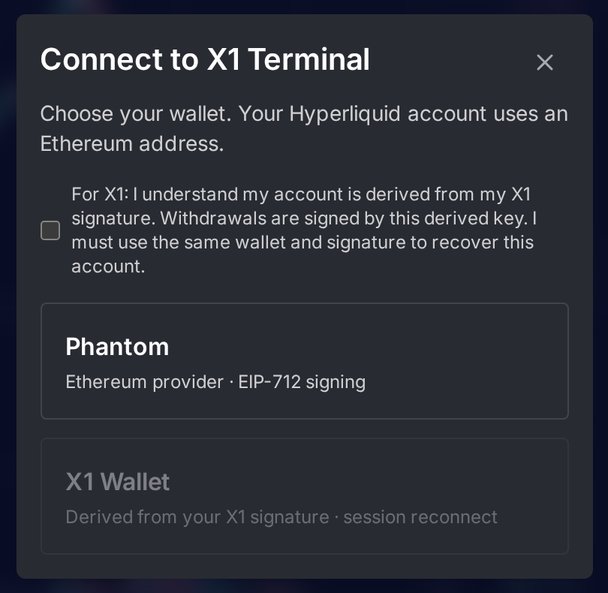
Before connecting with X1 Wallet you have to tick a box confirming that withdrawals are signed by the derived key and that you must use the same wallet and signature to recover the account. Take that seriously: lose access to the X1 wallet and you lose the path back to the Hyperliquid account.
How to start trading perps on X1 Terminal
- Open X1 Terminal and press Connect Wallet. Choose X1 Wallet (switched to the Solana network) or Phantom.
- Deposit SOL or ETH.
- Press the Bridge button in the bottom right corner to move the funds into your Hyperliquid account.
- Pick a market, set size and leverage, and go long or short.
Fees that buy XNT
X1 Terminal adds a 0.05% builder fee to each trade, shown next to the estimated 0.045% trading fee. Builder fees are how Hyperliquid lets front ends earn from the volume they route, and they are paid in USDC. Levin says that revenue will be used to buy XNT and reward users with it.
That fits a pattern. Over recent weeks Levin has announced an 85 million XNT burn, said burns will become a quarterly habit, and shown an exchange counter that turns its spread into XNT buybacks, moves we covered in X1's bet on a better economic model. A perp front end on the world's busiest on-chain derivatives exchange is a way to feed that machine with fees from outside X1. How large the buybacks get depends on volume, and the split between buying and rewards has not been published.
For scale: XNT trades at about $0.259. That is a market cap of roughly $11 million against a fully diluted value of about $281 million, because only 3.9% of the 1.08 billion supply is circulating. Live figures are on our XNT price page.
"Why not just use Hyperliquid?"
One user asked exactly that in the group: "Simple question...why anyone should use your app instead trade directly on hyperliquid? Lower risk and cost without 3rd party middle apps. This is waste of time in my opinion. Make leverage trading directly on X1." Levin's answer was three words: "Study paper trade." He did not expand on it, but the reply points at the token incentives: on X1 Terminal, trading fees are turned into XNT rewards for the users who generate them, something a trader on Hyperliquid's own front end does not get.
On top of the incentives, you get a login with X1 Wallet, trading without popups, and fees that flow back to XNT instead of to another front end. Fully native perps settled on X1 is what Levin means by the fast track. X1 Terminal is the first step, built on the venue where the liquidity already is.
Trade at your own risk
X1 Terminal is an early development product. Levin called it a candidate version and told users to use it at their own risk. Perpetual futures with leverage can be liquidated fast: at 40x, a 2.5% move against you wipes out the margin. Your funds sit in a Hyperliquid account after the bridge step, and with X1 Wallet that account depends on your X1 signature. Start small.
Sources: Levin's posts in the X1 World Telegram group, October 29 and 30, 2026; X1 Terminal as loaded October 30, 2026, 10:57 UTC; ICE and Trade[XYZ] announcement via CoinDesk and The Block; XNT supply from the x1scr.xyz stake API.