
Liquid staking on X1 lets you stake XNT and get a token back that keeps earning staking rewards while you can still hold, move or trade it. There are two liquid staking tokens on X1 today: pXNT, from the X1 Foundation's official stake pool, and rXNT, from Ripper Pool. Both work the same way under the hood. They differ in size, fees, how much XNT they keep in reserve, and how many validators they spread your stake across. This guide explains the mechanism, compares the two with live on-chain numbers, and walks through how to stake XNT, and how to get out again, step by step.
- You deposit XNT into a stake pool and receive pool tokens. The pool stakes the XNT with validators.
- Rewards are added to the pool every epoch (about 22 hours). Your token count never changes; each token simply redeems for more XNT over time.
- pXNT: 340.6 million XNT, 240 validators, 4% fee on rewards, 0.1% to deposit or withdraw. 1 pXNT = 0.9985 XNT.
- rXNT: 10.65 million XNT, 65 validators, 5% fee on rewards, no deposit fee, 0.2% to withdraw. 1 rXNT = 1.0647 XNT.
- In the latest epoch rXNT earned the equivalent of about 7.0% a year and pXNT about 4.5%. The gap comes mostly from how much XNT each pool leaves unstaked.
Native staking vs liquid staking on X1
X1 is a fork of Solana, so staking works the Solana way. With native staking you create a stake account, delegate it to one validator and earn that validator's rewards minus its commission. The XNT stays yours but it is locked in the stake account: to use it again you deactivate the stake, wait for the epoch to end, then withdraw.
With liquid staking a stake pool does the delegating for you, across many validators, and hands you a token that represents your share of the pool. That token is an ordinary token in your wallet.
| Native staking | Liquid staking (pXNT / rXNT) | |
|---|---|---|
| What you hold | A stake account | A transferable token |
| Validators | One, chosen by you | Dozens to hundreds, chosen by the pool |
| Rewards | Added to the stake account each epoch | Raise the token's exchange rate each epoch |
| Getting out | Deactivate, wait for the epoch to end (up to ~22h), withdraw | Withdraw from the pool, or sell the token on XDEX |
| Extra fees | Validator commission only | Validator commission plus the pool's fee |
| Can you use it in DeFi? | No | Yes: trade it, add it to liquidity pools |
How liquid staking works on X1
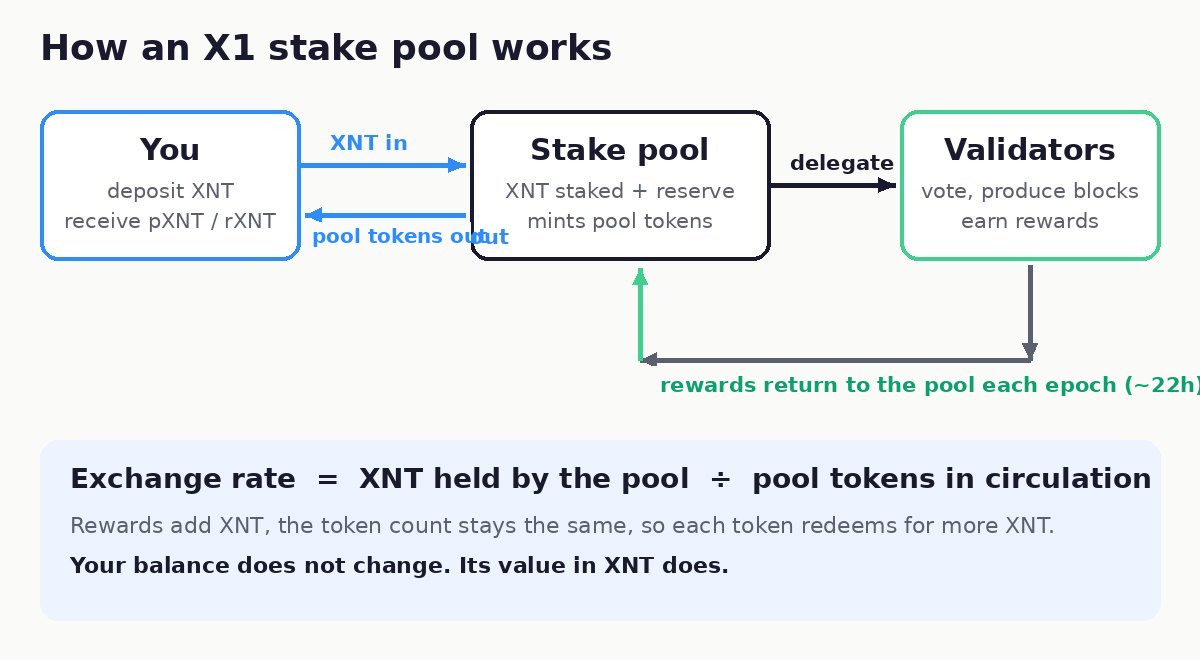
Both pXNT and rXNT are issued by the same on-chain program, X1's stake pool program at XPoo1Fx6KNgeAzFcq2dPTo95bWGUSj5KdPVqYj9CZux. It is X1's version of Solana's SPL Stake Pool, the program behind most Solana liquid staking tokens. Each pool is one account that tracks four things: the XNT it controls, the number of pool tokens in circulation, a list of validators it delegates to, and a reserve of unstaked XNT kept on hand for withdrawals.
The price of a pool token is set by one line of arithmetic:
When you deposit, the pool mints new tokens at the current rate, so existing holders are not diluted. When validators earn rewards at the end of an epoch, the pool's XNT grows but the token supply does not, so the rate goes up. That is the whole yield mechanism. There is nothing to claim and nothing to compound by hand.
A worked example with today's numbers: deposit 1,000 XNT into the official pool and, after the 0.1% deposit fee, you receive about 1,000.45 pXNT at 0.9985 XNT each. Deposit the same 1,000 XNT into Ripper Pool, which charges no deposit fee, and you receive about 939.2 rXNT at 1.0647 XNT each. Both positions are worth 999 to 1,000 XNT on day one. Fewer rXNT does not mean less value: rXNT has simply been accruing rewards for longer, so each one is worth more. Always compare positions in XNT, not in token counts.
pXNT: the X1 Foundation stake pool
pXNT is the token of the official stake pool run by the X1 Foundation, the same pool that powers the Foundation's stake delegation program. Its total, 340.6 million XNT, matches the delegation program's figure exactly, and the pool's validator selection follows the program's rules: at most 10% commission, at least 20,000 XNT of self-stake (the Capybara floor), no more than 1% of network stake per validator, and strong vote and skip-rate performance.
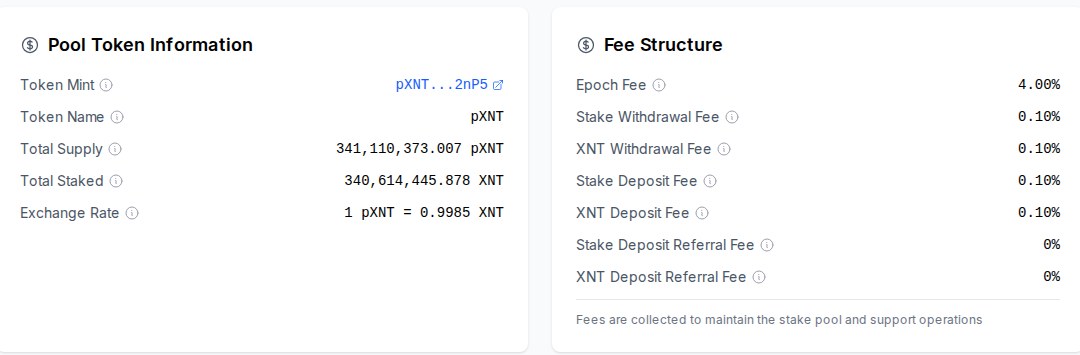
| Pool account | X1SPaMUM1A8E1vKL8XQAB5rxKarJbqtWFFSNFs8f7Av |
|---|---|
| pXNT mint | pXNTyoqQsskHdZ7Q1rnP25FEyHHjissbs7n6RRN2nP5 |
| XNT in the pool | 340,614,446 XNT |
| pXNT supply | 341,110,373 pXNT |
| Exchange rate | 1 pXNT = 0.9985 XNT |
| Validators | 240 |
| Reserve (unstaked) | 51.5 million XNT, 15% of the pool (the target is 10%) |
| Fee on rewards | 4% |
| Deposit / withdrawal fee | 0.1% / 0.1% |
| Latest epoch, annualized | about 4.5% |
The rate sits a fraction below 1 XNT. That is not a loss on your deposit: you buy pXNT at the current rate and sell at the future rate, so what you earn is the rise between the two, whatever the starting level.
Almost all pXNT is delegation-program stake: two wallets hold 99% of the supply, and one of them is the program authority shown on the pool's own info page. Retail holders own roughly 3 million pXNT. That changes nothing about how your pXNT earns, but it is why the pXNT market on XDEX is small (more on that below).
rXNT: Ripper Pool
rXNT is issued by Ripper Pool, the first liquid staking protocol on X1. It runs on the same stake pool program as pXNT, with its own settings: a smaller validator set, a thinner reserve and a different fee structure. The rXNT mint is a Token-2022 token.
| Pool account | R1PP3RkqTJniWgzJgeymd4rFpdpXcmjywVomMpd8eAY |
|---|---|
| rXNT mint | 7jP6rm8zEd2kLgt1vRTzmA11MmbhypHRdU1VyZPripp |
| XNT in the pool | 10,646,496 XNT |
| rXNT supply | 9,999,301 rXNT |
| Exchange rate | 1 rXNT = 1.0647 XNT |
| Validators | 65 |
| Reserve (unstaked) | 106,465 XNT, 1% of the pool |
| Fee on rewards | 5% |
| Deposit / withdrawal fee | 0% / 0.2% |
| Latest epoch, annualized | about 7.0% |
Each rXNT already redeems for 6.5% more XNT than it did at launch, which is the accumulated reward. Like pXNT, rXNT is concentrated: one wallet holds 99.7% of the supply, and it is the same wallet that holds 69% of all pXNT. You can see the live price on our rXNT price page.
pXNT vs rXNT: which pays more, and why
| pXNT | rXNT | |
|---|---|---|
| Run by | X1 Foundation | Ripper Pool |
| Size | 340.6M XNT | 10.65M XNT |
| Validators | 240 | 65 |
| Unstaked reserve | 15% | 1% |
| Fee on rewards | 4% | 5% |
| Deposit fee | 0.1% | 0% |
| Withdrawal fee | 0.1% | 0.2% |
| Latest epoch, annualized | ~4.5% | ~7.0% |
| Instant withdrawal capacity | Up to ~51.5M XNT | Up to ~106K XNT |
Staking on X1 pays about 6.9% a year gross, as we measured in our X1 vs Solana economics comparison. A pool can only pass that on for the XNT it actually stakes. The official pool keeps 15% of its XNT in reserve, earning nothing, and takes 4% of what the rest earns. Ripper keeps 1% in reserve and takes 5%. Roughly: 6.9% × 0.85 × 0.96 ≈ 5.6% for pXNT, and 6.9% × 0.99 × 0.95 ≈ 6.5% for rXNT, before validator commission differences. The measured single-epoch figures (4.5% and 7.0%) bounce around that from epoch to epoch, so treat them as a snapshot, not a promise.
The trade-off is the reserve itself. A big reserve is what lets the official pool pay out XNT instantly. Ripper's thin reserve earns more but can only pay out about 106,000 XNT instantly; a larger withdrawal comes out as a stake account that unlocks at the end of the epoch.
How to stake XNT and get pXNT
- Get XNT into an X1 wallet. Install X1 Wallet or Backpack (wallet setup guide) and fund it with XNT (how to buy XNT). Keep a little XNT unstaked for transaction fees.
- Open the official stake pool. Go to delegation.x1.xyz/stake and press Connect Wallet. X1 Wallet also has staking built in, which uses the same pool.
- Choose Stake and enter an amount. The page shows how much pXNT you will receive at the current exchange rate, after the 0.1% deposit fee.
- Approve the transaction. pXNT arrives in your wallet within seconds. Check that the token's mint is
pXNTyoqQsskHdZ7Q1rnP25FEyHHjissbs7n6RRN2nP5. - Hold it. Rewards are added every epoch through the exchange rate. You do not need to claim or restake anything.
How to get rXNT
- Fund an X1 wallet with XNT, as above.
- Stake through Ripper Pool. Open x1ripper.xyz, connect your wallet, enter the XNT amount and confirm. There is no deposit fee, so you receive XNT ÷ 1.0647 rXNT.
- Or buy rXNT on XDEX. On XDEX, swap XNT for rXNT using the mint
7jP6rm8zEd2kLgt1vRTzmA11MmbhypHRdU1VyZPripp. Compare the price per rXNT with the 1.0647 XNT redemption rate first: below it, buying is cheaper than staking; above it, stake directly instead. - Confirm the token in your wallet by its mint address, then hold it. rXNT grows against XNT every epoch like pXNT does.
How to unstake pXNT or rXNT
There are two ways out, and which is better depends on the size of your position and the market price at that moment.
- Check the redemption value. Multiply your balance by the pool's exchange rate (0.9985 for pXNT, 1.0647 for rXNT today). That is what the pool owes you, before the withdrawal fee.
- Check the XDEX price. Look up what the same amount fetches on XDEX, including price impact. The rXNT/XNT pool holds about $1,600 of liquidity and the pXNT/XNT pool about $570, so only small amounts sell close to fair value.
- Withdraw from the pool if it pays more. On delegation.x1.xyz/stake choose Unstake for pXNT; for rXNT use Ripper Pool's unstake option. Withdrawals are paid from the reserve instantly, minus 0.1% (pXNT) or 0.2% (rXNT).
- For large rXNT withdrawals, expect to receive part of your position as a stake account once the reserve (about 106,000 XNT) is used up. Deactivate it, wait for the epoch to end (up to ~22 hours), then withdraw the XNT.
What you can do with pXNT and rXNT
- Hold and let the exchange rate do the work.
- Provide liquidity in the XNT/pXNT or XNT/rXNT pools on XDEX. Because both tokens track XNT closely, impermanent loss is small, and you earn trading fees on top of staking rewards. The pools are small today, so your share of their fees can be meaningful.
- Move it. Unlike a stake account, pXNT and rXNT can be sent to another wallet in one transaction, with the staking position inside.
Risks to understand before you stake
- Program upgrades. The stake pool program behind both tokens is upgradeable, and its upgrade authority is the official pool's manager key. Whoever controls that key could change the code that holds both pools' XNT.
- Thin secondary markets. The XDEX pools for pXNT and rXNT hold hundreds to a few thousand dollars. Selling a large amount there means a steep discount; withdraw from the pool instead.
- Concentration. One wallet holds 99.7% of rXNT and two hold 99% of pXNT. If the largest holder withdraws, a pool's size, reserve and validator spread change overnight.
- Validator performance. Pool yields depend on the validators chosen. Delinquent or high-commission validators earn less, and the pool earns less with them.
For live staking totals and yields across the network, see X1 staking. For the token itself, see the XNT price page. If you would rather run the validator than delegate to one, start with how to run an X1 validator.
Frequently asked questions
What is liquid staking on X1?
Liquid staking means staking XNT through a stake pool that gives you a token back, pXNT or rXNT. The pool stakes your XNT with validators, rewards raise the token's value in XNT every epoch, and you can still hold, send or trade the token.
What is the difference between pXNT and rXNT?
pXNT comes from the X1 Foundation's official stake pool (340.6 million XNT, 240 validators, 4% fee on rewards, 15% reserve). rXNT comes from Ripper Pool (10.65 million XNT, 65 validators, 5% fee, 1% reserve). Both use the same stake pool program and earn through a rising exchange rate.
How much do pXNT and rXNT earn?
In the latest epoch rXNT earned the equivalent of about 7.0% a year and pXNT about 4.5%. The figure changes every epoch. The main reason rXNT earns more is that its pool keeps 1% of its XNT unstaked, against 15% for the official pool.
Why is 1 rXNT worth more than 1 XNT?
rXNT has been accumulating staking rewards since launch, so each token now redeems for 1.0647 XNT. Pool tokens only gain value against XNT as rewards come in; your balance stays the same.
Why is 1 pXNT worth slightly less than 1 XNT?
The official pool's rate is 0.9985 XNT per pXNT. What you earn is the increase in the rate between when you deposit and when you withdraw, so the starting level does not reduce your return.
How long does it take to unstake XNT on X1?
Withdrawing from a stake pool is instant as long as the pool's reserve covers it, minus a 0.1% (pXNT) or 0.2% (rXNT) fee. Native stake, or a large rXNT withdrawal paid as a stake account, unlocks at the end of the current epoch, which lasts about 22 hours.
Is liquid staking on X1 safe?
The main risks are that the stake pool program is upgradeable by the official pool's manager key, that the XDEX markets for pXNT and rXNT are small, and that both tokens are held mostly by one or two large wallets. Withdrawing through the pool, rather than selling on XDEX, avoids the thin-market risk.
Data: X1 mainnet stake pool accounts X1SPaMUM...f7Av and R1PP3Rkq...eAY, read October 30, 2026, epoch 426; validator lists, reserves and token holders from the same RPC; the official pool's info page at delegation.x1.xyz/info; XDEX pool liquidity from the x1scr token feed. "Latest epoch, annualized" compares each pool's exchange rate with the previous epoch's, over 397 epochs a year (epochs average 22.05 hours).